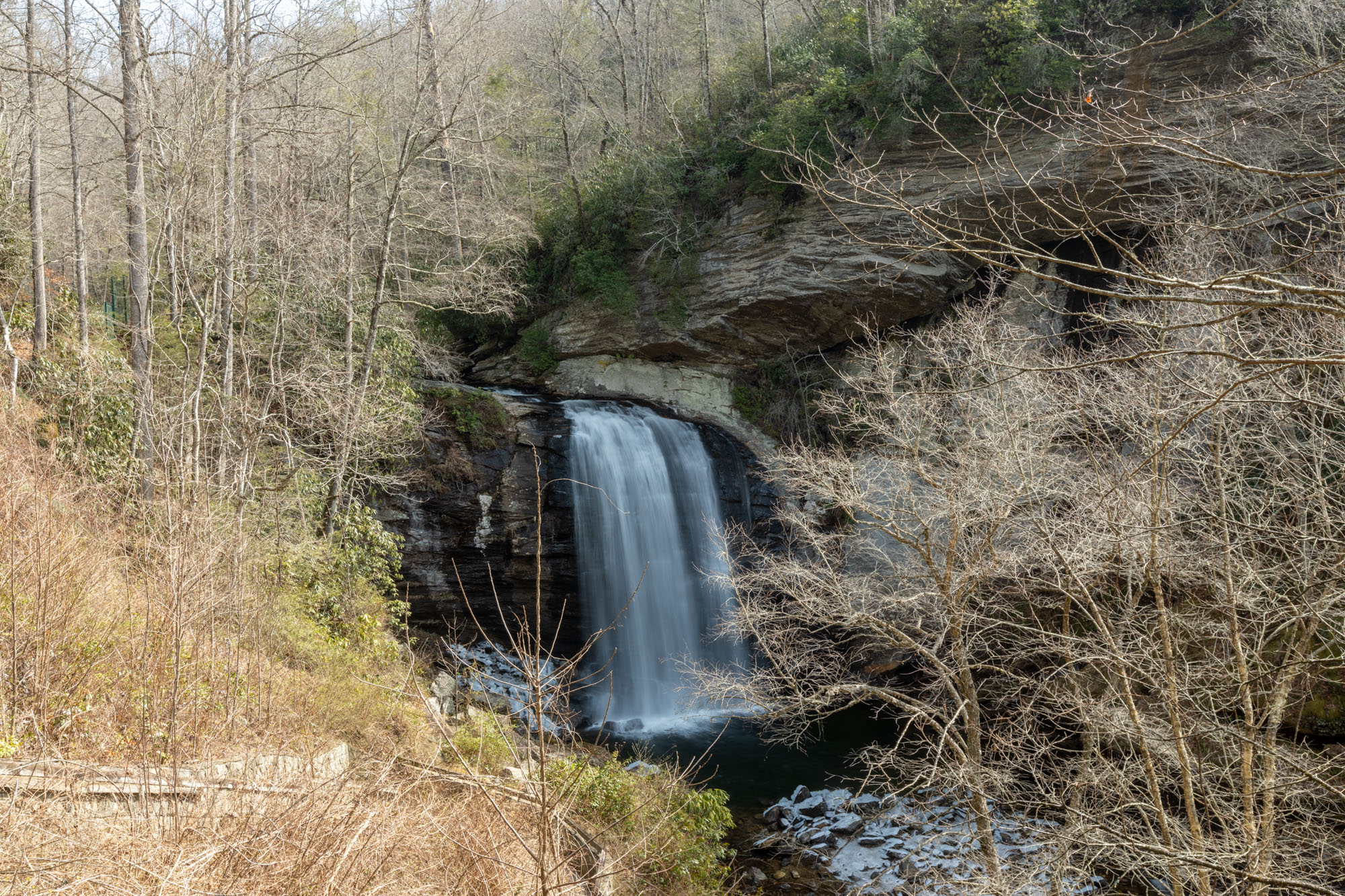
I figured I’d write this post-Helene so everyone could get an idea of what the falls look like in their current state. I will keep this updated if things change. I often visited Looking Glass Falls because it’s near my home.
This is the complete guide: what works, what doesn’t, when to go, where to park, and whether this is actually the right location for what you’re planning. No filler. If a section doesn’t earn its spot, it’s not here.
The honest up-front take
Looking Glass Falls is one of the most recognizable waterfalls in Western NC, right off US-276 in Pisgah National Forest with stairs down to the creek. That easy access cuts both ways. It can be genuinely stunning for a proposal or engagement. It is almost never the right call for a ceremony or elopement.
The US Forest Service explicitly lists Looking Glass Falls as a location they’re requesting the public not use for weddings sessions due to limited parking. Parking is limited, safety issues are real, and the layout funnels everyone into the same bottlenecks. After speaking with the U.S. Forest Service, I have confirmed that their main issue is parking and safety, they’re very concerned with the idea that someone could plan a wedding with hundreds of people at the waterfall. It could be a disaster.
Ceremonies and elopements: almost always no. No setup of any kind is accommodated. No chairs, no arbors, no decorations. If you need privacy, time, or control, you’ll fight for all three here. If guests are coming, even just a few, this location will create conflict.
The case for it
It’s a massive 60-foot-tall roadside waterfall that is absolutely beautiful in the heart of Pisgah National Forest. It is also right next to the road and has an observation deck with paved access to it, and it is ADA accessible. It also has a pool at the bottom that you can actively swim in so it’s easy to walk right to the base of the falls, and get some amazing photos and be at a very, very scenic area for either elopement or proposal.
Honestly, if you’ve never stood under a waterfall, especially a large waterfall, it just hits different. You feel energized standing under a waterfall. It’s an amazing experience whether you’re there for an elopement proposal or just to have fun.
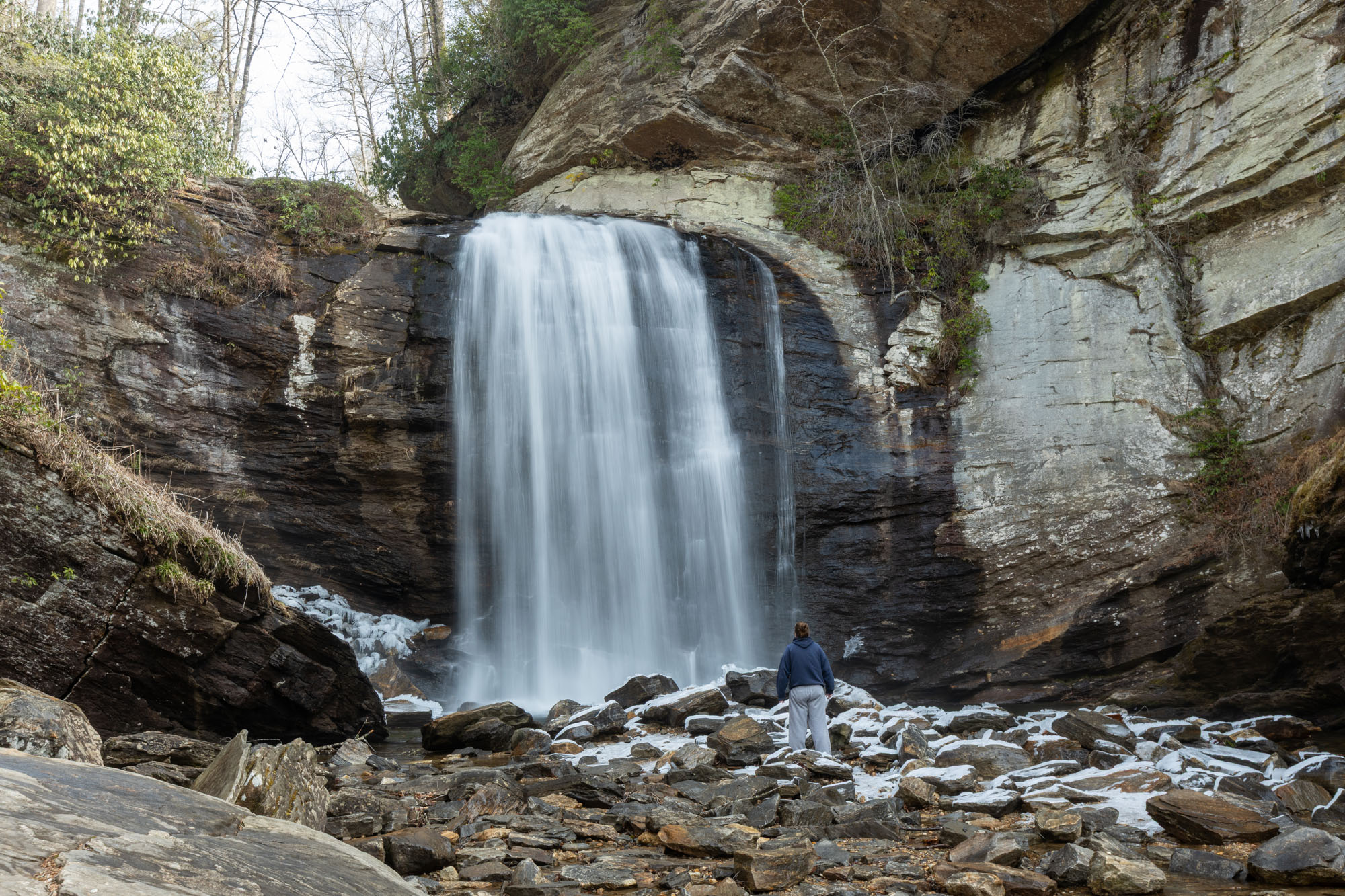
The best photos are always going to be from Looking Glass Creek, a.k.a. creek level. Being at creek level allows you to show the full scale of the waterfall. There is also a mound of rocks in front of the waterfall. That is a great place to pose, have a ceremony, have a proposal. All of those are a great location because it’s right in front of the waterfall. It’s slightly elevated above the creek and it allows the photographer to sit down at the creek and create amazing photos.
The case against it
If you’re not flexible, Looking Glass Falls is probably a poor choice. Things can go sideways there very easily. There could be a large crowd. It’s a public waterfall. You never know when 30 people are going to show up to go swimming or just hang out, take pictures, and watch the sunset at the waterfall. It happens.
There is also the weather. Looking Glass is a beautiful waterfall but if it’s been raining for a week before, it becomes a roaring river. You’re going to have to go way downstream or pick a new spot for your elopement. The good news is that there are so many scenic places nearby that it makes pivoting very easy. If you book a cabin nearby or a yurt nearby, and your plan is to elope and get married under Looking Glass Falls, but it’s been raining for the past week and the waterfall is more like a raging river, you can still go somewhere like Looking Glass Rock, John Rock, or Black Balsam.
All of these offer amazing views. There are also other waterfalls that come to life after heavy rains, and they are not raging rivers. Falls like Slick Rock Falls or Moore Cove Falls. My personal favorite in the summer is Cove Creek Falls, the Lower section, which we call Little Sliding Rock because it’s just like the Big Sliding Rock, where you can slide down the waterfall. There are also bathrooms, and there are a few group campsites. If you are flexible, there are plenty of options close by.
Other reasons not to choose Looking Glass Falls would be that you do not want to get wet. Even from the observation deck, it’s possible that the mist will come up to the observation deck. The best photos come at creek level so that means you will be getting somewhat wet if you want the best possible photos.
There are no bathrooms or any place to really change except the woods. There are picnic areas nearby that have bathrooms.
If you’re planning for your elopement to take place at the base of the falls, you will need to wear appropriate footwear and have decent balance. Those rocks are slick year-round, and waterfalls can be dangerous.
Call Julie. She’ll give you straight answers and help you pick the right spot.
828-243-2755Current conditions
Every photo on this page was taken post-Helene. This is what you’re working with right now.
Entrance to Pisgah National Forest, Brevard
Lower deck view
Upper deck (ADA accessible)
Creek level, person for scale
Rock landing at creek level
Observation deck and seating
Upper parking lot
Lower parking lot
At a glance
Season by season
The visual character of Looking Glass Falls changes with the seasons. Each one is a completely different shoot.
This is the most unique season. The “Looking Glass” effect occurs when ice builds up on the cliff face. The falls can be surrounded by icicles, and the lower visitor volume gives you the best chance at privacy. The path down to the base can be dangerously icy and slippery, though. Arrive 60 to 75 minutes before sunrise. Creek window opens about 10 to 25 minutes after sunrise. If there’s ice on the stairs or rocks, stay conservative.
Avoid creek-level entirely on icy mornings.
Following seasonal rains, the falls are at their most powerful, with significant mist. The forest is filled with fresh green foliage. Weather is unpredictable. Sunrise gives you the fog/mist bonus and the quiet window. Arrive 55 to 70 minutes before sunrise. Best creek window is 15 to 45 minutes after sunrise.
Spring rocks look dry and aren’t. Plan footwear accordingly.
This is the most challenging season for ceremonies. The base of the falls becomes a swimming hole, and privacy is nearly impossible. The heat makes the mist feel refreshing, but background noise from families and swimmers can disrupt everything. Sunrise is the only real option for anything that feels private. Arrive 60 to 75 minutes before sunrise. Leave before swimmers arrive.
Sunset at creek-level in summer means competing with people cooling off, mist on your lens, and humidity wrecking hair and wardrobe.
Mid-to-late October brings fall color to Pisgah Forest. Waterfall plus fall color is the best visual combination here. Leaf-peeper traffic is the tradeoff. Sunrise is your best weapon against the crowds. Arrive 70 to 90 minutes before sunrise. Creek window is 20 to 50 minutes after sunrise. Shoot tighter to minimize background people as the morning fills in.
Book 6+ months out for fall dates. They go fast.
Planning details
Looking Glass Falls sits right along US-276, making it one of the more accessible waterfalls in the region. Coming from Brevard, head north on US-276 for roughly six miles and you’ll spot it roadside. Traveling from the other direction, turn off the Blue Ridge Parkway onto US-276 South and drive about 10 miles. Best of all, the falls are free to visit and accessible any time of day or night.
Start by merging onto I-240 West, which transitions to I-26 East. Follow I-26 East until you reach Exit 40, signed for Highway 280 and the Asheville Regional Airport. Turn right onto Highway 280 West and follow it for 16 miles as it winds toward Brevard. Once you approach town, watch for a large shopping center on your right anchored by a Walmart. Just beyond that shopping center, turn right onto US-276 North, also marked as the Forest Heritage Scenic Byway, which takes you into Pisgah National Forest. Stay on US-276 for six miles, and Looking Glass Falls will appear on your left.
Let’s start with the basics. The parking lot is in great shape. It suffered no damage from Hurricane Helene. There is an upper parking lot that you can pull right up to the waterfall if you’re the first one there. Peak season, you should count on this place being incredibly busy midday because it’s a huge waterfall right next to the road. However, even in peak season, I find that it is generally empty at sunset or first thing in the morning for sunrise. It’s not uncommon to have the place to yourself even in peak season.
There is also a second gravel parking lot that is much lower and has even more room for cars. I would say this is one of the most parking-friendly waterfalls in Pisgah, if not the most friendly.
The upper observation deck is ADA accessible. Paved path, level ground, seating available. If someone in your group uses a wheelchair or has limited mobility, the upper deck gives them a full view of the falls with zero obstacles.
Creek level is a different story. You’ll need to navigate stairs and uneven, slippery rocks. Good balance and proper footwear are not optional.
If you’re staying on the observation deck, wear whatever you like. Creek level is a different situation. Wear shoes with grip that you don’t mind getting wet. Skip heels entirely. Layers work well because the gorge runs cooler than the surrounding area. Bring a change of clothes and a towel.
There are no bathrooms at the falls. Nearby picnic areas have restrooms, so plan accordingly.
In the event of rain an easy backup plan that is covered would be the Pink Beds. They have covered sheltered areas there that may or may not be open. You also have the Cradle of Forestry nearby, which, depending on who you talk to, may or may not be open for a small elopement. There are also several other picnic areas that have covered areas, such as Sycamore Flats at the entrance to Pisgah.
Where to do it
This is the safest and most accessible option. Paved path, seating, and a clear view of the falls. If you have guests with mobility issues or you want to keep things simple, this is the spot. The mist can reach the deck on heavy flow days, so bring a cloth for your partner’s ring hand if that matters to you.
As of February 2026, the view is partially obstructed in late spring through early fall by a tree in the foreground. They generally cut that down. There is also a tree in the lower falls that partially blocks the view, but you can still see most of the waterfall.
Closer to the falls, more intimate. You’ll feel the mist here, which actually makes for better photos because it catches the light. This spot gives you the waterfall as a close backdrop without requiring rock-scrambling. You will get somewhat wet. Plan for it.
This is the most dramatic spot and where the best photos happen. The mound of rocks right in front of the waterfall is slightly elevated above the creek. It puts you right in the scene with the full scale of the falls behind you. Your photographer can sit at creek level and shoot upward for photos that show the full 60-foot drop.
The tradeoff: those rocks are slick year-round. You need decent balance and appropriate footwear. This is not the spot for heels or dress shoes. If you’re willing to get wet and be careful, the photos from here are on another level compared to the deck.
Legal details
The U.S. Forest Service does not require a permit for small gatherings, generally under 75 people total. A two-person elopement with a photographer and an officiant is a completely different thing than a wedding, and the Forest Service treats it that way.
That said, the Forest Service is requesting people not use Looking Glass Falls for weddings and photo sessions. The line between “elopement” and “event” is about impact. If you’re in and out in under an hour with 2 to 4 people, you’re not the problem they’re worried about.
If you want privacy, time to breathe, any kind of setup, or guests present, Looking Glass Falls is the wrong location. The layout doesn’t accommodate what a ceremony requires. Better options on the same US-276 corridor are a phone call away.
Looking for more elopement locations? Check out the full Asheville Elopement Guide.
No waiting period. Get your license in the morning, marry at the falls that afternoon.
From a photographer’s perspective
The gorge stays shaded, so you’re not chasing golden-hour light on the waterfall itself. Timing is about crowds, comfort, mist, and safety. Arriving before sunrise, not at sunrise, is what actually gets you the quiet window.
The sun rays (crepuscular rays) that make for those “viral” waterfall photos are not a daily occurrence. They require a specific recipe: high moisture in the air (either from recent rain or heavy mist), a cold night that creates ground fog, and a clear sunrise where the light hits the valley at a specific angle. These conditions are most common on autumn mornings between 8:30 AM and 9:30 AM. If a couple wants that specific look, the photographer should watch for mornings when the humidity is above 95% and the forecast is for clear skies.
Mist from the falls is constant at creek level and reaches the lower deck regularly. Your photographer needs to know how to manage spray on the lens without losing the moment. This is not a set-up-a-tripod-and-wait kind of location. It’s move fast, protect the gear, shoot between gusts of mist, and adapt on the fly. A photographer who has shot here before will know the rhythm of the spray and how to use it as backlight rather than fight it.
Every phone photo at Looking Glass Falls looks roughly the same: person standing in front of a waterfall, blown-out sky, flat lighting. A professional who knows this location will put you at creek level where the scale of the falls fills the frame, time the shoot for the right light and crowd conditions, and move efficiently enough that you’re not blocking the trail or drawing attention.
The difference between a phone snapshot and a professional image from this spot is not subtle. It’s the difference between a photo you post once and forget about and one that stops people mid-scroll.
Winter: arrive 60 to 75 min before sunrise. Creek opens 10 to 25 min after. Spring: arrive 55 to 70 min before. Best window is 15 to 45 min after sunrise. Summer: arrive 60 to 75 min before. Leave before swimmers arrive. Fall: arrive 70 to 90 min before. Shoot tighter as morning fills in.
I shoot at Looking Glass Falls regularly. I know the timing, the spots, and the backup plans.
828-243-2755Common questions
No. The U.S. Forest Service does not require a permit for proposals or small gatherings at Looking Glass Falls, generally under 75 people total. You can show up, propose, and leave without any paperwork. That said, a two-person proposal with a photographer moving efficiently is a very different situation than a posed session with tripods, outfit changes, and a blocked trail. Keep it quick and courteous.
Technically yes, but with major caveats. The U.S. Forest Service explicitly lists Looking Glass Falls as a location they are requesting the public not use for weddings and photo sessions due to limited parking and safety concerns. A two-person elopement (couple plus photographer, maybe an officiant) during an off-peak time is workable. Anything beyond that creates problems. No setup is accommodated. No chairs, no arbors, no decorations.
North Carolina does not have a waiting period for marriage licenses, so you could get your license at the Transylvania County Register of Deeds in Brevard in the morning and marry at the falls that afternoon. The license is valid for 60 days.
The upper observation deck is ADA accessible with a paved path from the upper parking lot. There is seating at the observation deck as well. The lower deck and creek level are not ADA accessible and require navigating stairs and slippery rocks. If someone in your group has mobility issues, you can pull right up to the entrance and drop them off at the observation deck. The ground is level concrete and asphalt from the drop-off point to the seating area.
There are two parking areas. The upper parking lot is paved and sits right next to the falls. If you are first to arrive, you can pull right up to the waterfall. The lower parking lot is gravel, larger, and has more capacity but requires a short walk. This is one of the most parking-friendly waterfalls in Pisgah National Forest. During peak season, expect the upper lot to be full midday. Early morning and sunset, even in peak season, the lot is often empty.
Pro tip: if the lot is full and you have someone with mobility issues, pull up to the front entrance to drop them off, then drive up the road to the picnic area to turn around and park in the lower lot.
The gorge stays shaded, so you are not chasing golden-hour light on the waterfall itself. Timing is about crowds, comfort, mist, and safety. Arriving before sunrise, not at sunrise, is what actually gets you the quiet window. The best photos come from creek level, and early morning gives you the smallest crowds and the best chance at fog and mist.
If you want those sun rays (crepuscular rays), they require high humidity above 95%, a cold night that creates ground fog, and a clear sunrise. Most common on autumn mornings between 8:30 AM and 9:30 AM.
Each season is a completely different experience. Fall (September through November) gives you waterfall plus fall color, which is the best visual combination, but leaf-peeper traffic is the tradeoff. Winter (December through February) is the most dramatic with potential ice formations on the cliff face and the lowest crowds, but the highest slip risk. Spring (March through May) has the strongest water flow and fresh greens with possible morning fog. Summer (June through August) is lush and green but the creek turns into a swimming hole fast, so privacy is nearly impossible after mid-morning.
Approximately 37 miles from downtown Asheville, about a 45-minute drive. Take I-240 West to I-26 East, exit at Highway 280 toward Brevard, then turn right onto US-276 North into Pisgah National Forest. The falls will appear on your left after about six miles on US-276.
About 9 miles, roughly a 15-minute drive north on US-276. Head north on US-276 and you will spot the falls roadside on your left.
Yes. There is a pool at the bottom of the falls that people actively swim in, especially during summer. You can walk right to the base of the falls at creek level. Keep in mind those rocks are slick year-round. If you are planning to be at the base of the falls, wear appropriate footwear and have decent balance. Waterfalls can be dangerous.
It is a massive roadside waterfall in Pisgah National Forest, so expect crowds midday during peak season. You never know when 30 people are going to show up to go swimming or just hang out and take pictures. However, even in peak season, the falls are generally empty at sunset or first thing in the morning for sunrise. It is not uncommon to have the place to yourself if you time it right. Weekday mornings are your safest bet for privacy.
If you are staying on the observation deck, wear whatever you like. If you are going to creek level for the best photos, you will get wet. The mist from the falls reaches even the observation deck at times. For creek level, wear shoes with good grip that you do not mind getting wet. Skip heels entirely. Layers work well because the gorge can be cooler than the surrounding area. Bring a change of clothes and a towel. There are no bathrooms at the falls, but nearby picnic areas have restrooms.
Looking Glass Falls does not officially close, but after heavy rain it becomes a roaring river. If it has been raining for a week, you will need to go way downstream or pick a new spot. The good news is that there are plenty of scenic alternatives nearby on the same US-276 corridor: Looking Glass Rock, John Rock, Black Balsam, Slick Rock Falls, Moore Cove Falls, and Cove Creek Falls are all close by. Flexibility is key when planning around this waterfall.
The parking lot suffered no damage from Hurricane Helene and is in great shape. The falls and surrounding area are accessible and open. This guide was written post-Helene specifically so people could get an idea of what the falls look like in their current state. The photos throughout this page reflect current conditions as of early 2026.
For a proposal, 60 to 90 minutes is typically enough. That gives your photographer time to get in position before you arrive, capture the moment, and then shoot portraits together after. A two-person proposal with a photographer moving efficiently works well here. Anything longer starts to compete with other visitors for space.
Proposals are designed for people who are proposing at Looking Glass Waterfall and just need a proposal or a Proposal Plus engagement session at Looking Glass in the surrounding area. Elopements are designed for people who intend to get married. Either they did it earlier that day at the courthouse or they actually want to get married under the falls. Call us at 828-243-2755 to talk through which option fits your plans.
You can have your dog on a leash. However, you will be walking across slick rocks, so if your dog pulls you could be in trouble. Just be careful.
As of February 2026, the view is partially obstructed in late spring through early fall. There is a tree growing in the foreground that they generally cut down (believed to be an invasive Bradford pear). There is also a tree in the lower falls area that is a permanent resident and partially blocks the view. You can still see most of the waterfall from the observation deck.
Whether you’re proposing, eloping, or just want engagement photos with a 60-foot waterfall behind you, let’s figure out the right plan. I shoot here regularly and know every angle, every season, and every backup option.
828-243-2755